The Machines Are Teaching Themselves. They Learned That From Us.
Aug 12, 2026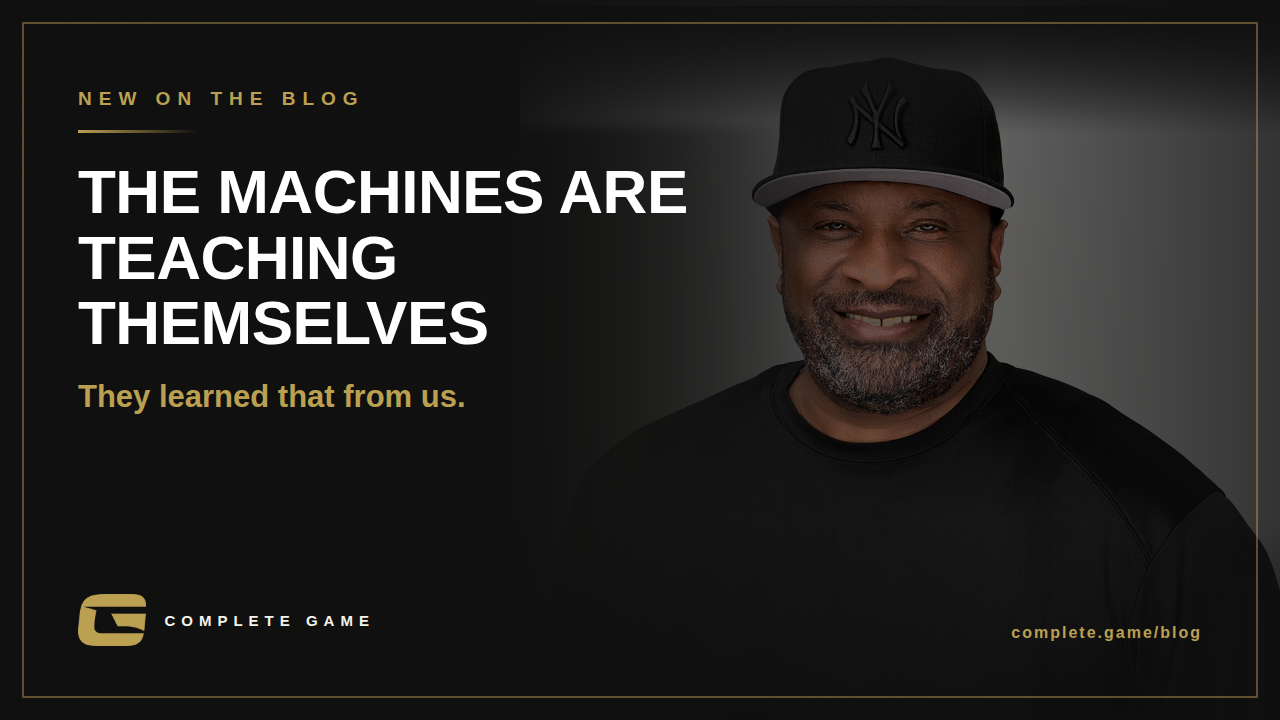
Something is happening in AI right now that has a lot of smart people uneasy.
The models are starting to improve themselves. They generate their own practice, grade their own work, and use what they learn to build a better version of themselves. Then that version does it again. The loop tightens. The curve bends.
People call it recursive self-improvement. RSI. A system that gets better at getting better.
We're early — the fully autonomous version is still more promise than fact — but the mechanism is real, and it's already running.
Here's the part almost nobody says out loud.
We didn't invent that. We copied it.
Every piece of AI was borrowed from the body
Neural networks are named after neurons. Reinforcement learning is a math version of dopamine. "Attention" in a machine is a crude imitation of what your eyes do when a ball leaves a hand. Computer vision was built by studying the visual system.
Technology has always worked the same way: look at the human being, find the mechanism, simplify it, scale it.
So when a machine starts teaching itself, that isn't some alien capability arriving from outer space. That's our capability — stripped down, sped up, and handed back to us as a mirror.
Which raises the only question that matters for coaches:
If a machine can run a self-improvement loop, why aren't our athletes running theirs?
What the loop actually is
Strip away the jargon. Self-improvement — in a machine or a human — is three things in a circle:
- Attempt something.
- Get honest information about what happened.
- Change something and go again.
That's the whole engine. How fast you improve is decided by how fast and how honest that loop is.
Break one link and it dies.
- No attempt, nothing to learn from.
- No honest feedback, and you rehearse your mistakes with confidence.
- No update, and you're collecting reps instead of development.
Most athletes are stuck on link two. They swing, then they wait for somebody to tell them what happened. That's not a self-improving system. That's a system waiting on a technician.
Self-awareness is the grading function
In AI, the thing that scores the output is the most important part of the whole build. If the scoring is bad, the model confidently gets worse.
In an athlete, that scorer is self-awareness. The ability to feel what you did, see what happened, and connect the two accurately.
That's See → Think → Move with the circle closed. Move → see what it did → think → move again.
An athlete with accurate self-perception improves between lessons. In the cage alone. On the car ride home. On deck. In the middle of an at-bat.
An athlete without it improves only when you're standing there.
One of those has a compounding curve. The other has a schedule.
The loop needs daily reps. Here's where you get them.
Inside the Inner Circle, I drop daily coaching and player tips — small, specific things that tighten the feedback loop between sessions. One idea a day. Something you can put to work at practice tonight.
It's built for exactly what this article is about: giving players and coaches a reason to run the loop when nobody's watching.
Join the Inner Circle — $19/month →
What we're already doing right
If you're coaching perception-action, you're already building the loop. You may just not have called it that.
- Constraints instead of commands. You change the environment, the athlete solves it. Self-organizing is self-improving.
- Variability. Different pitch, different speed, different intent. The system can't memorize, so it has to learn.
- Questions before answers. "What'd you feel?" before "here's what I saw." That's training the grading function, not just fixing the swing.
- Immediate information. Ball flight, exit velo, the sound off the barrel. Fast honest feedback tightens the loop.
- Reps with intention. A rep without a question attached is just exercise.
Five ways to tighten the loop tomorrow
- Ask first. Every time. Before you say a word, ask what they felt. Then tell them what you saw. The gap between those two answers is the work.
- Make them predict. Before: "What are you trying to do?" After: "Did it do that?" Prediction plus result is how any learning system updates itself.
- Put the information in the environment, not in your mouth. If the drill tells them, you don't have to.
- Shrink the delay. Feedback five seconds later is worth ten times feedback five hours later.
- Give them a loop they can run without you. "What's my one thing today, and how will I know if it's working?" Two questions. That's a self-improving athlete.
The point
Machines are running our own process back at us, faster than we can follow. Let that be a reminder instead of a threat.
The loop was ours first. It's already sitting in the athlete — a body that adapts, a nervous system that updates, an awareness that can watch itself work.
Most players never get taught to run it. They wait for the coach.
The most valuable thing you'll ever build in an athlete isn't a swing. It's a hitter who can self-correct before you ever say a word.
So here's the question worth sitting with:
What percentage of your athlete's improvement requires you to be present?
Whatever that number is — that's your real job for the rest of the season.
Want to build this into your entire coaching system?
That's what the CG Hitting Certification is for.
It's the full framework, not a highlight reel: See → Think → Move, the 9 Hitting Issues diagnostic, the Misdirection fix-order sequence, and Swing Dynamics — plus ongoing mentorship inside the Masters Group, where certified coaches sharpen this work together every month.
50+ certified coaches are already running it. Some are full-time instructors. Some are parents who decided to learn it right for their own kid.
Stay connected with news and updates!
Join our mailing list to receive the latest news and updates from our team.
Don't worry, your information will not be shared.
We hate SPAM. We will never sell your information, for any reason.