The Math Behind Hard Contact by Rob Crews
Jan 28, 2026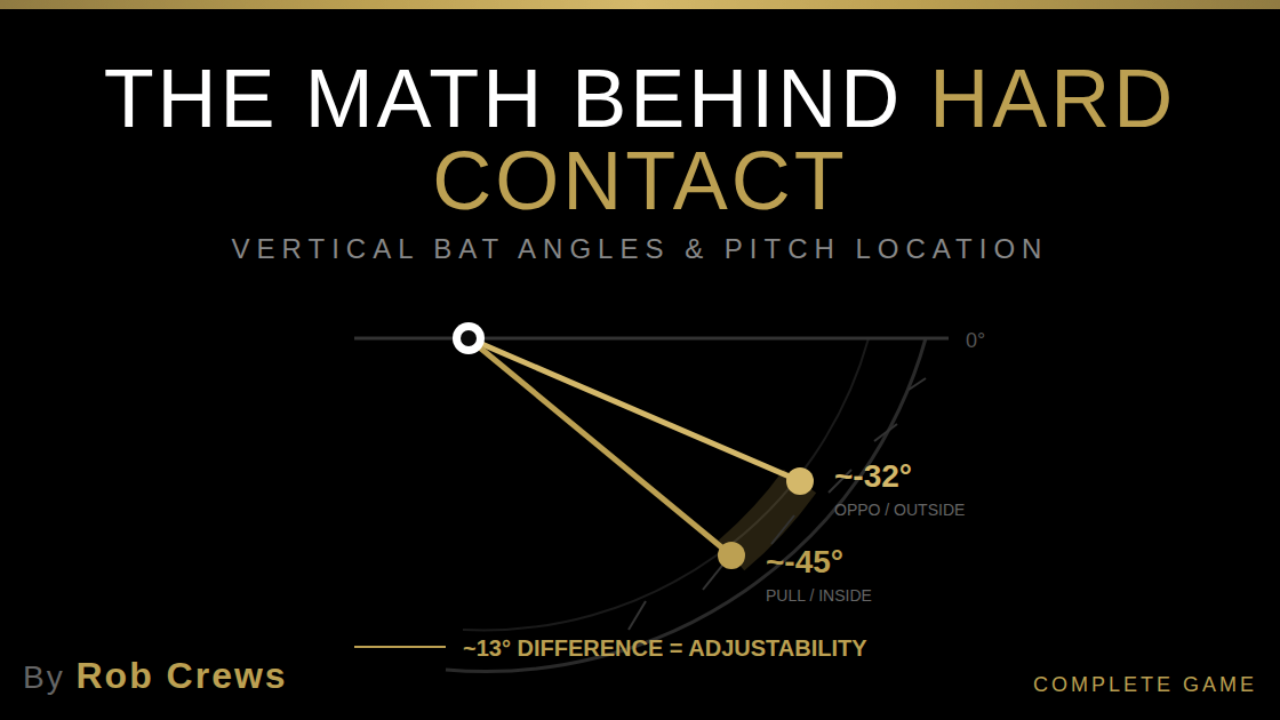
The Math Behind Hard Contact | Complete Game

Every pitch has a specific angle that must be hit to barrel it up. It's really just mathematics playing out at contact points.
When I talk to hitters about making adjustments, most of them think in terms of "inside" or "outside" — horizontal location. But elite hitters are processing something far more nuanced. They're adjusting their vertical bat angle based on pitch location, and they're doing it instinctively.
Let's break down what that means.
What Is Vertical Bat Angle?
Vertical bat angle is simply the angle of the bat at contact, measured from horizontal.
- 0° A perfectly flat, level swing (horizontal baseline)
- ~-32° A flatter angle, typical for opposite-field contact
- ~-45° A steeper angle, typical for pulling inside pitches
"Different pitch locations require different angles."
The Statcast Evidence
Look at Mike Trout's data. When he pulls the ball on inside pitches, his vertical bat angle is closer to -45°. When he goes the other way on outside pitches, it flattens out to around -32°.
That's roughly a 13° difference — and that difference is what separates elite adjustability from one-dimensional hitting.
Same hitter. Different angles. That's what makes him elite.
Pitch Location Rules
Here's the framework:
Vertical Plane
Higher pitches → Flatter angle
Lower pitches → Steeper angle
Horizontal Plane
Outside pitches → Flatter angle
Inside pitches → Steeper angle
The Extremes
Every Pitch Has Three Dimensions
This is where it gets interesting. Every pitch has three dimensions your hitter must process:
-
1
Vertical Plane
Is it high or low?
-
2
Horizontal Plane
Is it inside or outside?
-
3
Depth
Where should contact occur? (In front of the foot, even with the foot, or deeper)
Elite hitters process all three dimensions and adjust their vertical bat angle accordingly. Average hitters only think about one or two.
Why Posture Comes First
Here's the coaching takeaway that matters most:
"You can't create the mathematics if you don't have the right posture."
Try this: Stand completely upright and attempt to create a -45° bat angle at contact. You'd have to contort your body unnaturally to make it happen.
Now try it with a 10-15° forward lean toward the plate. Suddenly, the full range of vertical bat angles becomes available to you.
Posture gives you the ability to be adjustable and adaptable. Without it, you're limited to a narrow range of pitches you can actually barrel up.
The Coaching Application
When I work with hitters, I'm not thinking "swing down" or "swing level." I'm thinking about whether they have the postural freedom to create the angle each pitch location demands.
If a hitter keeps popping up outside pitches to the pull side, they're probably bringing a steep angle (-45°) to a pitch that requires a flat angle (-32°). The fix isn't mechanical — it's postural. Give them the freedom to adjust, and the adjustment happens naturally.
Key Takeaways
- Vertical bat angle is the angle of the bat at contact, measured from horizontal
- Different pitch locations require different angles
- Inside and low pitches require steeper angles (closer to -45°)
- Outside and high pitches require flatter angles (closer to -32°)
- Posture enables adjustability — without it, you can't create the angles
- Every pitch has three dimensions: vertical plane, horizontal plane, and depth
The Bottom Line
The math is there. The question is whether your hitters have the postural foundation to execute it.
Eyes lead the body. Body leads the barrel. And posture makes the math possible.
Ready to Develop Elite Adjustability?
Work with Complete Game to build the postural foundation your hitters need.
Stay connected with news and updates!
Join our mailing list to receive the latest news and updates from our team.
Don't worry, your information will not be shared.
We hate SPAM. We will never sell your information, for any reason.