Two Hitters. Same Bat Speed. Only One of Them Can Hit.
Aug 26, 2026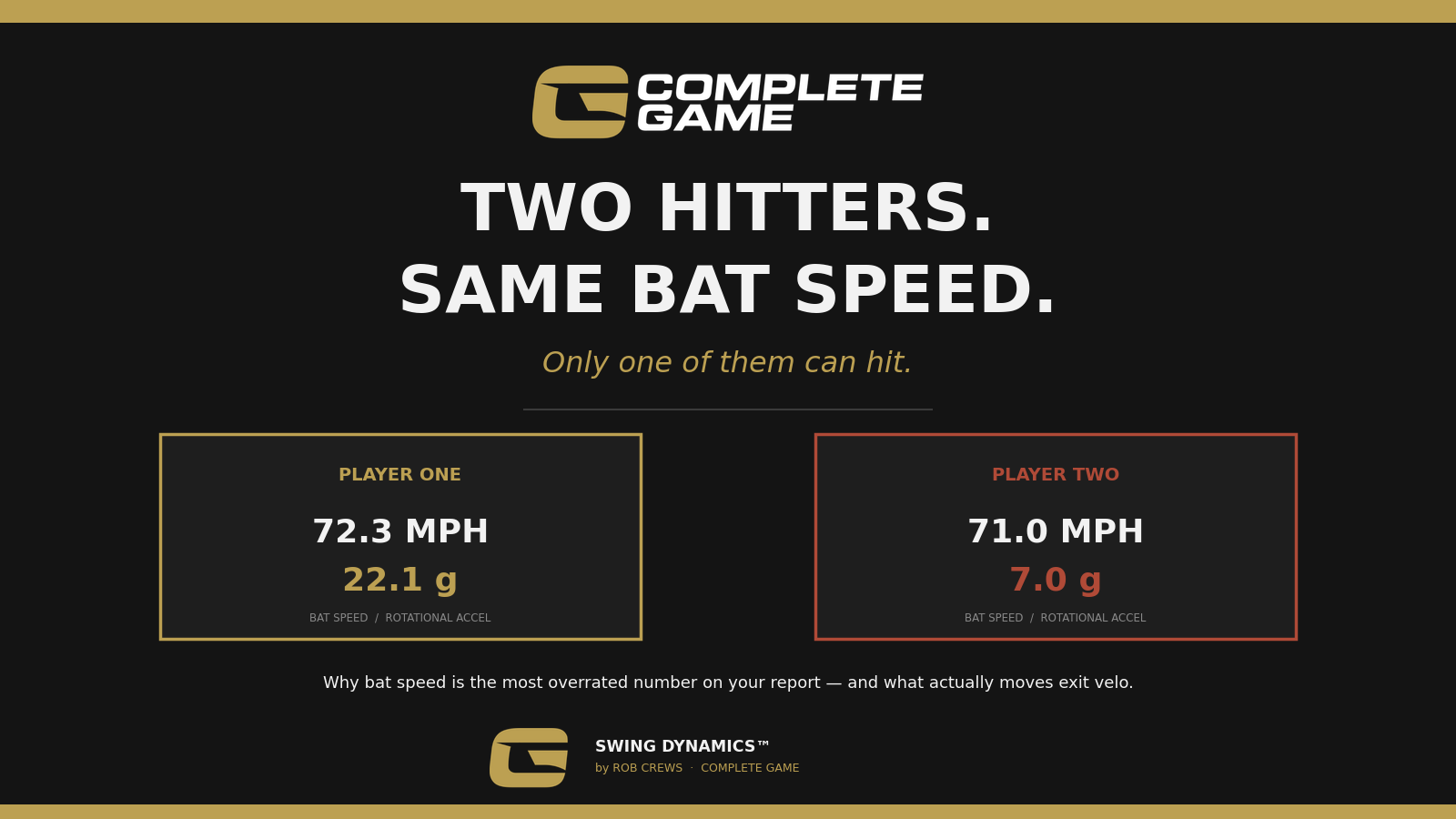
The number on your report is lying to you by omission
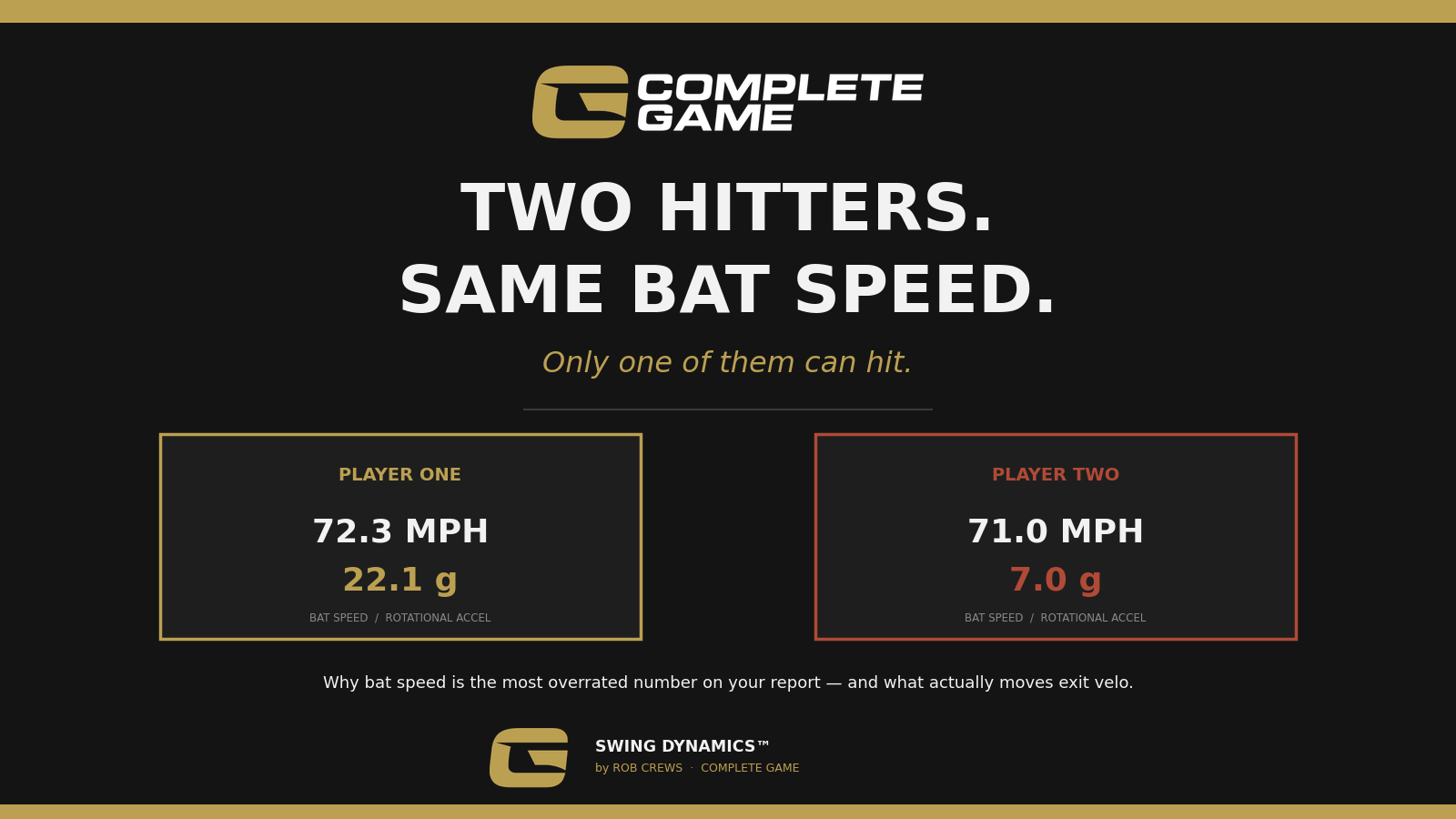
Driveline Baseball ran two professional hitters through paired Blast, K-Vest, and HitTrax capture.
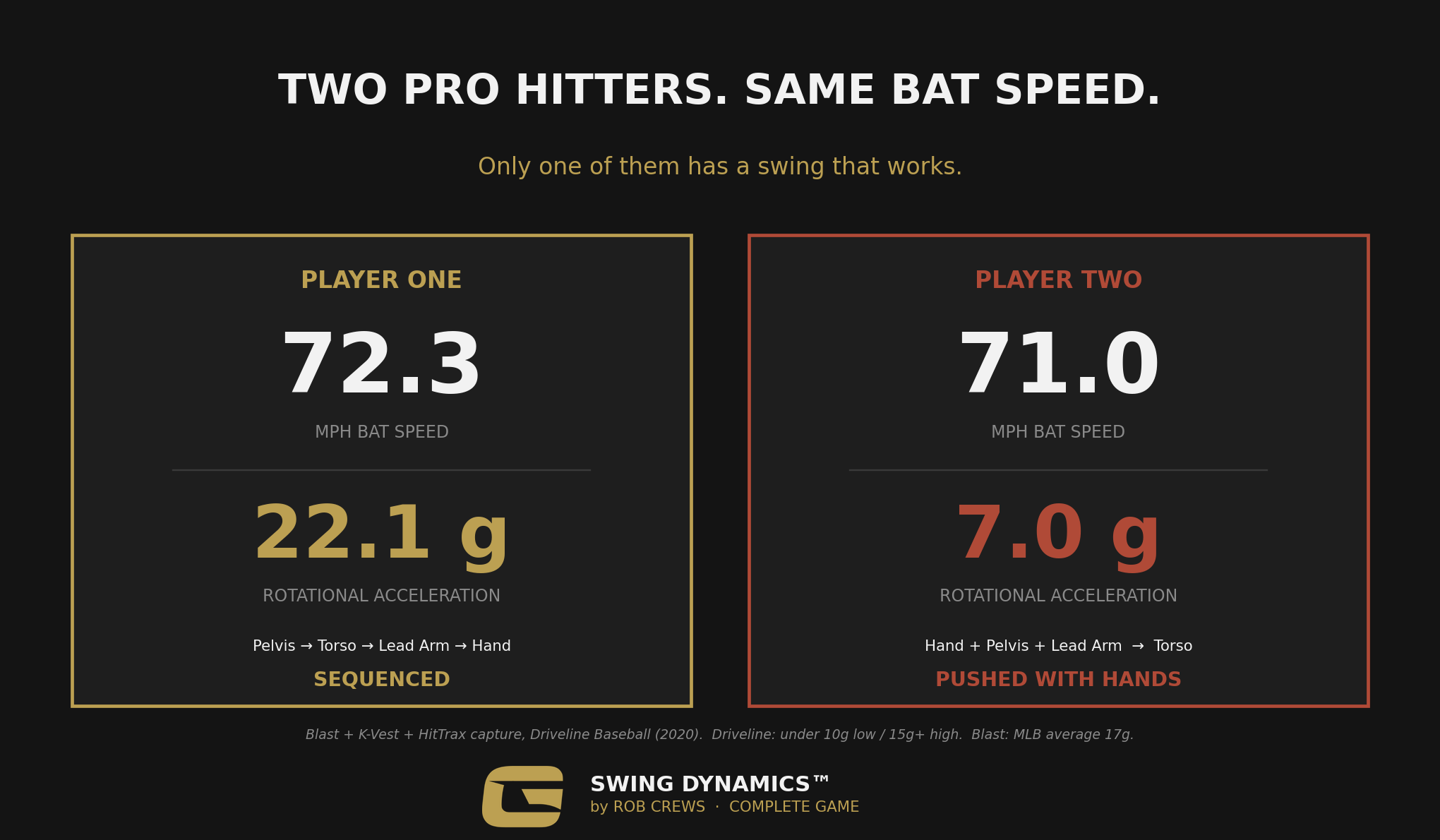
Player One averaged 72.3 mph bat speed. Player Two averaged 71 mph.
On a bat speed leaderboard, these two are the same hitter.
They are not the same hitter.
Player One's rotational acceleration was 22.1 g. Player Two's was 7 g — well under the low threshold Driveline uses internally, where anything below 10g is low and 15g and up is high. Blast puts the MLB average at 17.
Same barrel speed. Wildly different swings. And the motion capture shows exactly why.
What the 7g swing was actually doing
Driveline's sequence data tracks whether a hitter fires in the correct order: pelvis, torso, lead arm, hand. Player Two's torso reached peak speed third instead of second — his hand, pelvis, and lead arm all accelerated before his torso did.
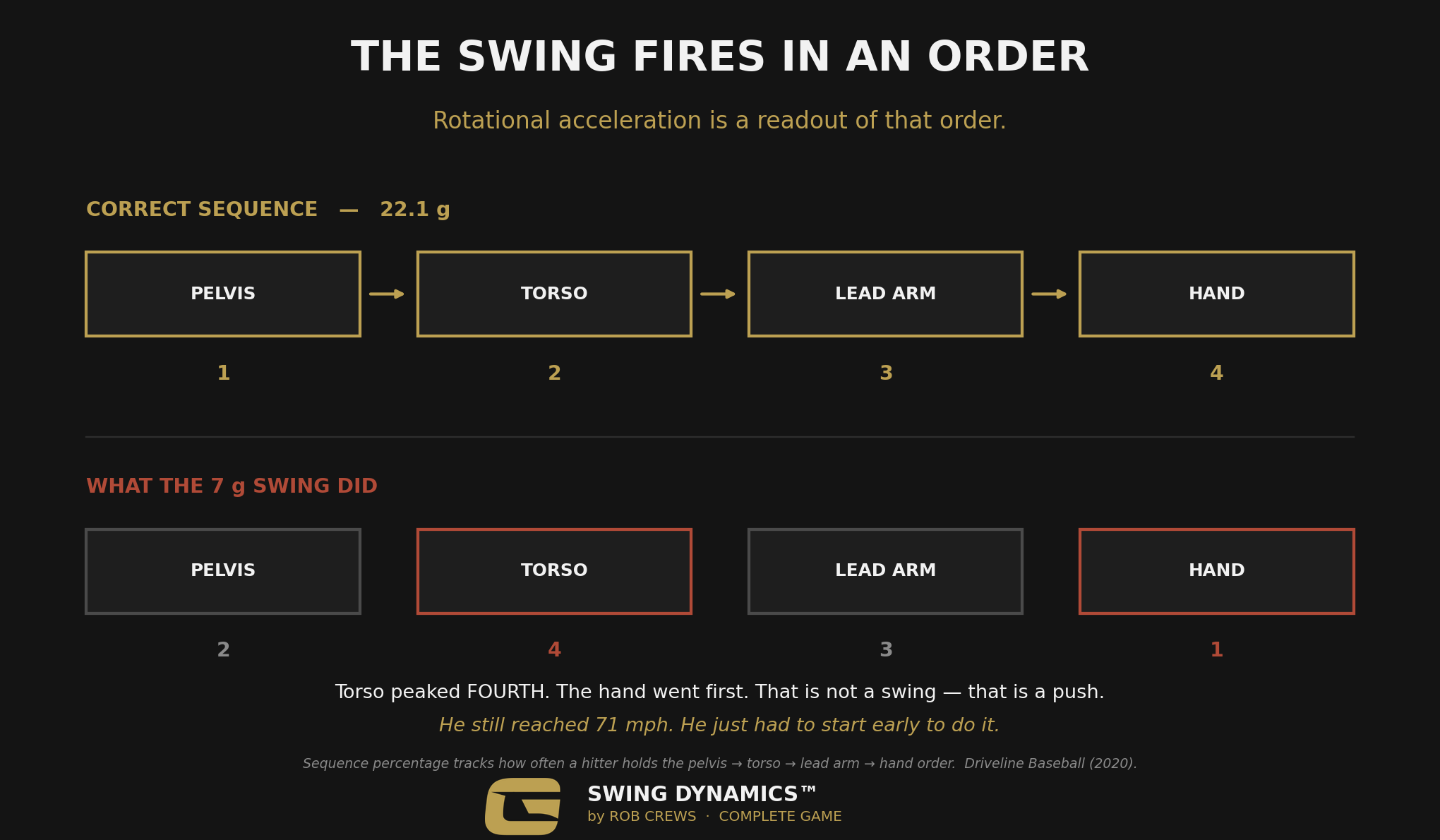
He wasn't sequencing the bat. He was pushing it with his hands.
He still got to 71 mph. He just had to start earlier and work harder to get there, and he had to commit before he knew what the pitch was.
That is a hitter whose number looks fine and whose swing does not work. He exists on every roster in America, and a bat speed reading will never find him.
Why this decides at-bats, not just reports
Driveline found rotational acceleration and peak hand speed both run negatively against time to contact. Faster into the plane means less time spent getting there — which means the hitter can decide later, with the ball closer, holding more information.
Then there's the finding that should end the argument. They split hitters at 13g and charted exit velocity against contact point, adjusting each hitter to his own average to strip out talent.
The high-acceleration hitters stayed above their own average exit velocity across a wider window of contact depth. They didn't just hit it harder in one spot. They hit it hard in more spots.
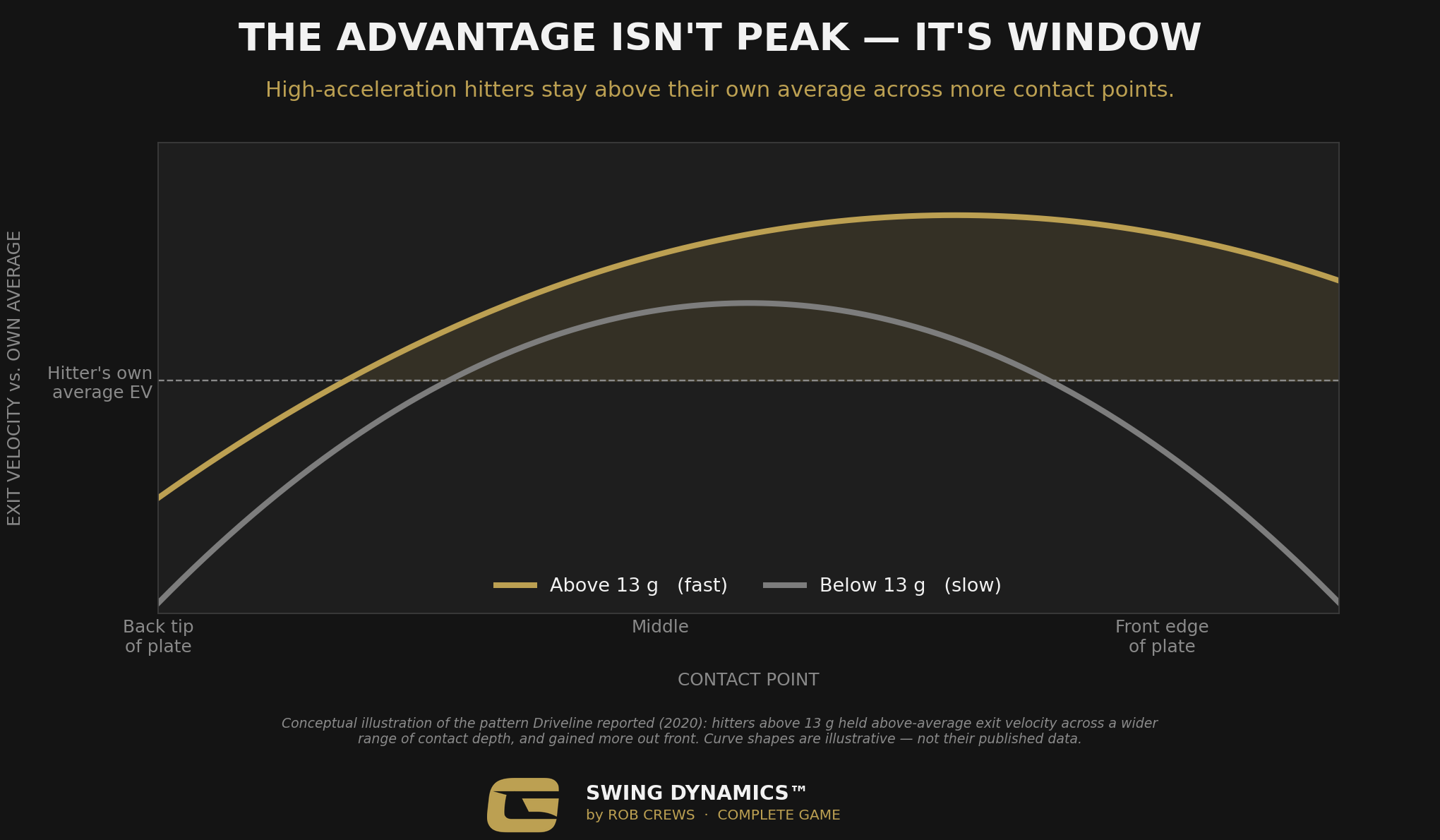
That's the whole game. Not peak output in a cage. Repeatable output across the range of contact points a real at-bat actually produces.
And it's the direct answer to the problem underneath everything: the speed-accuracy trade-off. Swing faster, lose precision — it's one of the oldest findings in motor control, and it doesn't care how strong you are. The recent work in The American Statistician quantified the baseball version: hitters who slow down with two strikes do make more contact, but the power they give up roughly cancels the gain. Trading speed for accuracy is a wash.
Winning means refusing the trade. Raising the speed at which you're still accurate.
You cannot lift your way there. You have to reorganize the swing.
Here's the part I want you to sit with
At the end of that same article, Driveline lists how to actually train rotational acceleration. Their prescription, not mine:
- Long bat — sequencing and bat path
- Bat speed trainer (weighted) — sequencing, swing direction, rotation
- Short bat — using the torso and body more effectively
- Offset rotation, and training against velocity
Long bat. Weighted bat. Short bat.
That is the Swing Dynamics™ system. The most respected independent R&D group in baseball, with no stake in my business, arrived at the same four tools I've been cutting for hitters for twenty-five years.
What makes ours different: it's cut to your athlete
Most training bats are sold as a weight. Ours are sold as a percentage.
Every Swing Dynamics™ set is built off the hitter's own game bat.
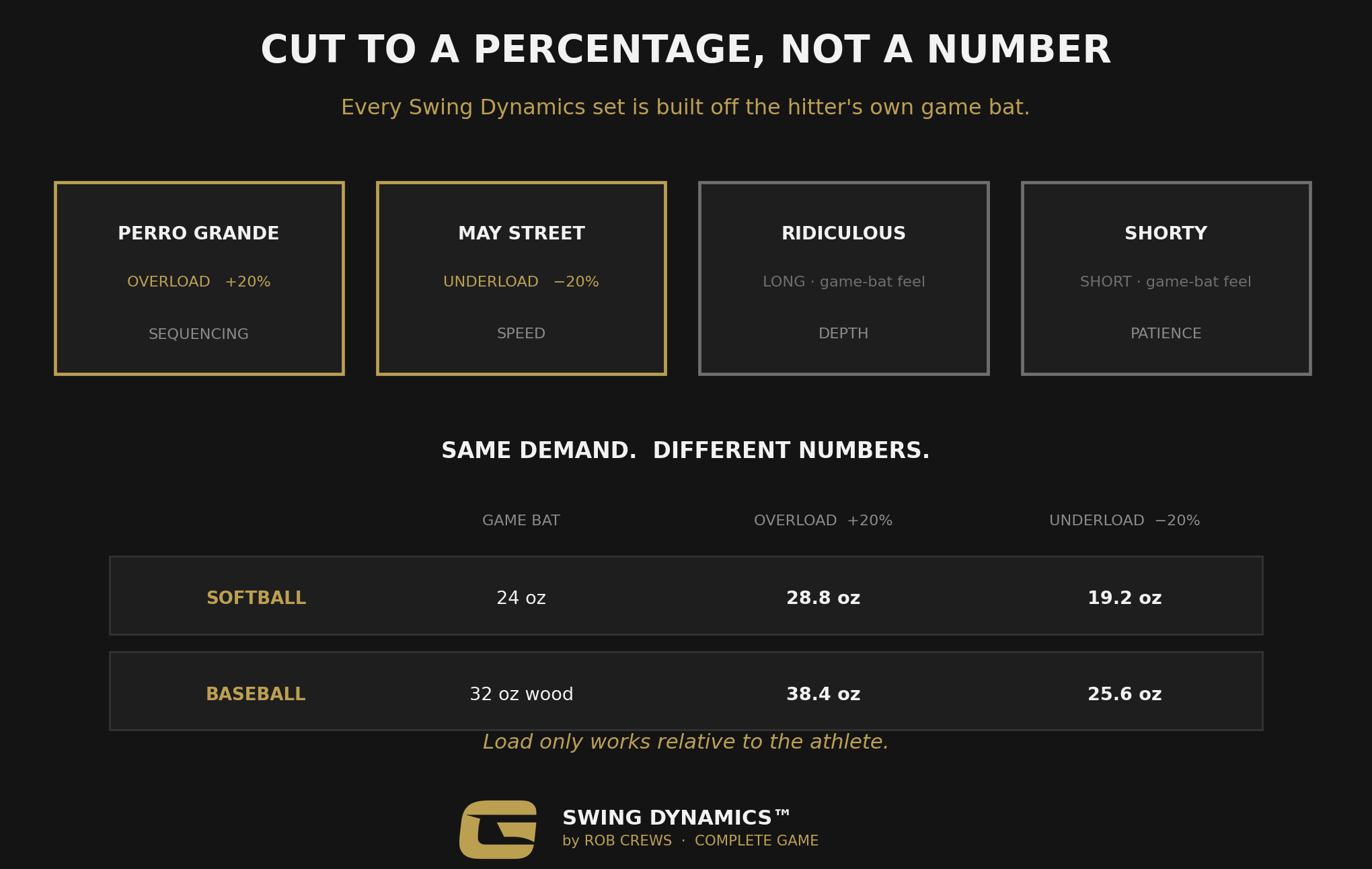
A softball player swinging 24 ounces gets a 28.8 overload and a 19.2 underload. A baseball player on 32 ounces of wood gets 38.4 and 25.6. Different numbers. Identical demand.
This matters more than it sounds. Hand a 14-year-old fastpitch player a bat built for a college baseball player and you don't teach sequencing — you teach compensation, because she'll recruit whatever she has to just to move it. Hand a strong college hitter a youth trainer and nothing happens at all. Load only works relative to the athlete.
The short and long bats hold weight constant on purpose. Change length and weight together and you can't tell which one the hitter is responding to. Holding the feel steady isolates the depth problem cleanly — which is exactly the window the Driveline contact-depth data says separates hitters.
Why four and not one
The physics is counterintuitive and most coaches have never seen it. Smith, Broker, and Nathan's field study found a player's swing speed tracks the bat's moment of inertia — how the mass is distributed — and is nearly independent of the bat's weight when that distribution is held constant.
Translation: the swing doesn't respond to ounces. It responds to how the implement behaves in space.
Change that four different ways and you hand the athlete four different movement problems. She solves them herself. Nobody has to think about mechanics — the bat does the teaching. That's the entire premise, and it's why the system works on a 12-year-old and a college hitter alike.
The bottom line
Bat speed is real. Roughly 1.2 mph of exit velocity for every 1 mph you add — that's Nathan's collision physics, and it's the most direct payoff in the sport.
But bat speed you can't access on time, in the window, against real pitching is a cage number.
You must improve the swing to increase bat speed. Not the other way around.
Four bats. Cut to your hitter. That's how you do it.
Get the Bats
The Swing Dynamics™ system is available now at completegame.shop.
The complete 4-bat set — $600. Perro Grande™, The Shorty™, May Street™, and Ridiculous™, cut in Custom Pro Maple and built off your hitter's own game bat. Sold in dedicated baseball and softball versions so the profile matches the implement your athlete actually swings.
Or start with one bat — $139 each. For the first time, the bats are sold individually, so you can go straight at the specific breakdown in your swing.
- Perro Grande — sequencing, overload +20%. Start here if your accel number is low and you push the bat with your hands.
- May Street — speed, underload −20%. Start here if you need to feel a ceiling you've never touched.
- Ridiculous — contact depth and body control. Start here if you're out front and can't let the ball travel.
- Shorty — connectivity and patience. Start here if you lunge and your barrel is late to the window.
Softball versions of each individual bat are available on the same store.
Stop chasing the number on the report. Fix the swing that produces it.
Shop the Swing Dynamics bats →
Sources: Aydt, A. — "Rotational Acceleration, Sequencing, and the Swing," Driveline Baseball, 2020 · Blast Motion metric definitions and MLB benchmarks · Nathan, A. M. — The Physics of Baseball, University of Illinois · Smith, Broker & Nathan — softball swing speed field study, RMIT 2003 · Powers et al. — "Swinging, Fast and Slow," The American Statistician, 2026
Chart note: the contact-depth graphic is a conceptual illustration of the pattern Driveline reported, not a reproduction of their published data.
Stay connected with news and updates!
Join our mailing list to receive the latest news and updates from our team.
Don't worry, your information will not be shared.
We hate SPAM. We will never sell your information, for any reason.